


Old Goa
Spend time away from the beach and Goa’s famous nightlife. In only 20 minutes from Panaji, you can be at Old Goa or Velha Goa and witness its rich history and heritage. Between the 16th and 18th centuries, what is now Old Goa, used to be bigger than London and Lisbon. The city was called the Rome of the East because of its impressive cathedrals, churches, towers, and other structures. You can still see that grandeur today. See the Basilica of Bom Jesus, the tomb of St. Francis Xavier, Se Cathedral, church of St. Cajetan, and the Viceroy Arch. Many of them are still in use and are UNESCO Heritage sites. Other historical buildings have been converted into museums. A few of them are in ruins.
A trip to Old Goa will be a fascinating day trip. It is only 13.4 kilometers east of Panaji on the banks of the Mandovi River. If you leave in the morning, you can return to Panaji and have your lunch. You can extend your trip by visiting the Divar Island on the opposite side of the river. Divar has a mangrove swamp where you can see many birds and crocodiles. End your day at Fontainhas or the Latin Quarter, which is also a UNESCO Heritage Zone. It will be a wonderful way to discover another side of Goa.
Velha, which is now Old Goa, was established by the Bijapur Sultanate in 1510. The Portuguese arrived and made it their capital, which was moved to Panaji in 1843 after Velha was ravaged by plague, cholera and malaria. At its peak, 200,000 people used to stay here.
Old Goa Map & Location
Arrival Of The Portuguese And The History Of Old Goa
Vasco da Gama landed on the Malabar Coast from Portugal, today’s Kerala, to trade spices in 1498. It was a successful trip as he wanted to become the premier supplier of spices to Europe from the east, ousting Venice. He went back with cinnamon, ginger, pepper, musk, and amber. The Portuguese became interested and planned to monopolize the trade from Asia. They needed a local base. The first base was established at Cochin. However soon, operations expanded beyond the Malabar.
The same year, the Portuguese entered into an alliance with the Vijayanagara Empire to attack Goa. The Bijapur Sultanate was weak and was disliked by the local merchants. They welcomed the Portuguese. Goa was finally conquered.
Velha Goa, which Bijapur built to replace Govapuri, was made the capital of Portuguese India. The city would serve as the base for a long time.
During Portuguese rule, there were 7 markets in Old Goa. Traders came here from Arabia, China, Zanzibar, and other parts of India to trade in cotton, spices, perfumed oils and silk. There used to be markets for goldsmiths, blacksmiths, meat, fish, and even one market only for diamonds.
Old Goa – Quick Facts
|
Old Goa, also called Velha Goa is located on the northern bank of the Mandovi River, 13.4 kilometers from Panaji. |
The city was established by the Bijapur Sultanate in 1510. Taken over after a Portuguese attack. |
|
The Portuguese made this the first capital of Goa. It was the administrative center and also a trading post. |
At its peak Velha Goa was a thriving metropolis with a population more than London and Lisbon. The city was often called ‘Rome of the East’. |
|
The Portuguese were able to defeat many attacks by the Marathas, Omanis, and the British. However, Portuguese trade diminished as the Dutch and English became more powerful. |
Eventually, the capital of Portuguese India shifted from Velha to Panaji in 1843, but this was because of health issues. There were repeated attacks of malaria, cholera and plague that killed many people. |
|
Portuguese heritage and culture is still visible in Old Goa in the many churches, cathedrals, and old buildings. |
There is a lot to see in Old Goa – UNESCO World Heritage sites, cathedrals, chapels, tombs, ruins, arch, and more. |
How To Reach Old Goa
- By Air — The Goa International Airport at Dabolim is 26.4 kms from Old Goa. Taxis are available for rent at the airport counter. There are many flights from Air India, Indigo, Etihad, Air Arabia, Air Asia, Qatar Airways, and Jet Airways. The new Mopa airport is 41.4 kilometers away.
- By Rail — The Karmali Railway Station is only 2.7 kms from Old Goa. It is an easy walk from here. You can also take an auto-rickshaw from the station. The price will be approximately 30 INR.
- By Road — You can also take a bus from the Panaji bus stand, 13.4 kms from Velha. There are lots of buses that leave every few minutes. The ride will take about 20 minutes with average traffic. You can also drive in your hired car or bike through the Panjim — Belagavi Road to reach Old Goa.

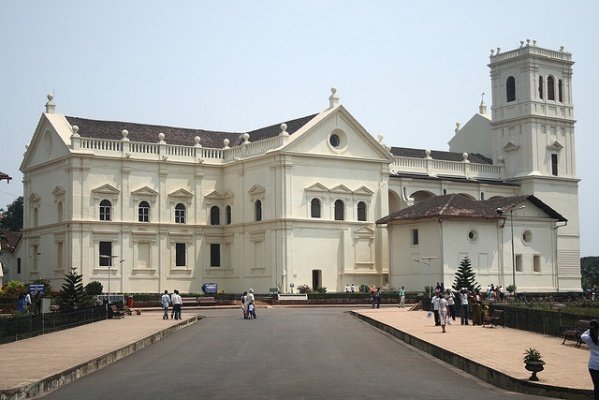
Se Cathedral, Old Goa
Top 7 Places To Visit In Old Goa
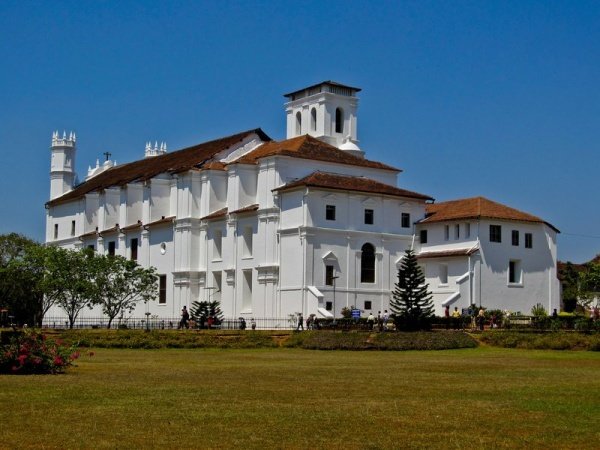
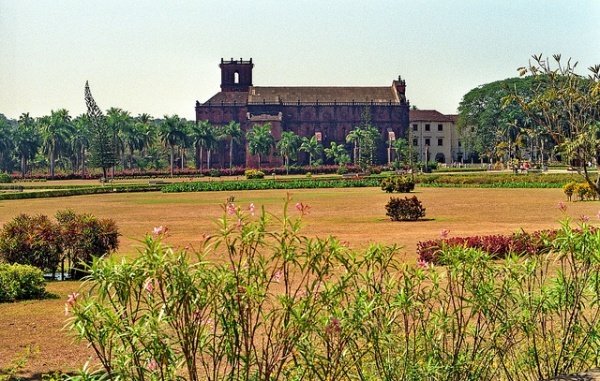
- Basilica of Bom Jesus – This is a famous 16th century Baroque Catholic church and a UNESCO Heritage site. It has a very beautiful red laterite stone façade and an equally impressive inside. There are Latin and Portuguese inscriptions on the pillars and walls. See the Baroque and Jesuit architecture, Doric and Corinthian works. There is a huge and ornate screen behind the altar that stretches from the floor to the ceiling. An annual feast is held on 3rd December, preceded by a nine-day devotional novena, when there are solemn open-air masses. Basilica of Bom Jesus is the highlight of the Old Goa trip.
- Tomb of St. Francis Xavier – The mortal remains of St. Francis Xavier are kept within the Basilica of Bom Jesus. There is a coffin is on display outside this chapel. The tomb was made by the famous Italian sculptor, Giovanni Batista Foggini. St. Francis Xavier opened many churches in India and also looked after the sick. He died in China, but his body was brought back to Goa because of his good work. The body of this famous evangelist is given an exposition once in ten years, when pilgrims from throughout the Catholic world come to Goa.
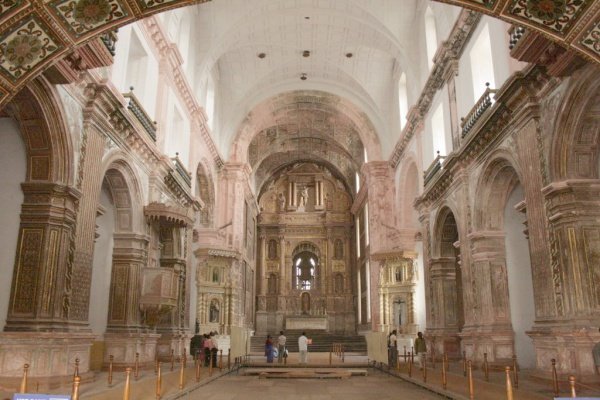
- Se Cathedral – Dedicated to St. Catherine, this is Asia’s largest church. It is 55 meters wide and 76 meters long. True to Tuscan traditions, both the outside and inside of this cathedral has a plain design. The church also has the famous Golden Bell or the Sino de Ouro, which is Asia’s largest. The bell was tolled during the inquisitions or the trials of faith. It was heard from a distance of 14 kilometers. To the right, there is a locked area where there is a font that was used by St Francis Xavier. There are statues of St Ignatius Loyola and St Francis Xavier. The ceiling and walls of Chapel of the Blessed Sacrament are gorgeously decorated and gilded.
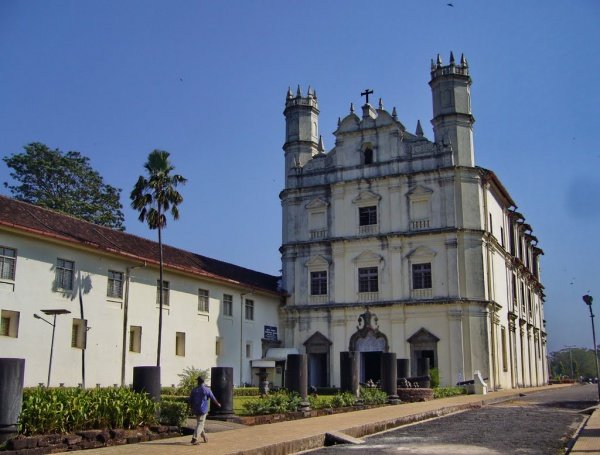
- Church of St. Cajetan – St. Cajetan was an Italian reformer and priest. Pope Urban III sent three Italian friars to India to spread Christianity. They arrived in the modern-day Hyderabad, but their mission failed. The friars moved to Goa and managed to convince the king of Portugal to allow them to practice alongside the Portuguese priests. The Church of St. Cajetan was constructed, modeling it after Rome’s Basilica of St. Peter. Its main alter is dedicated to Mother Mary. An annual feast is held every year on 7th August. Workers, job seekers, gamblers, and bankers also come here to pray in front of St. Cajetan, asking for good luck.
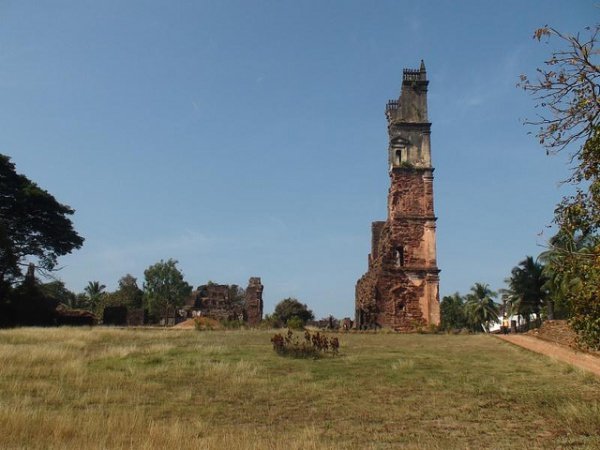
- Ruins of St. Augustine – This is located a short distance away from the Basilica of Bom Jesus. It was constructed in the 1600s but collapsed between 1842 and 1938. At its peak, the Iberian architecture here was considered one of the three best in the world. All you can see now is the 43 meter high tower. It sits on top of the Monte Santo Hill in Velha Goa.
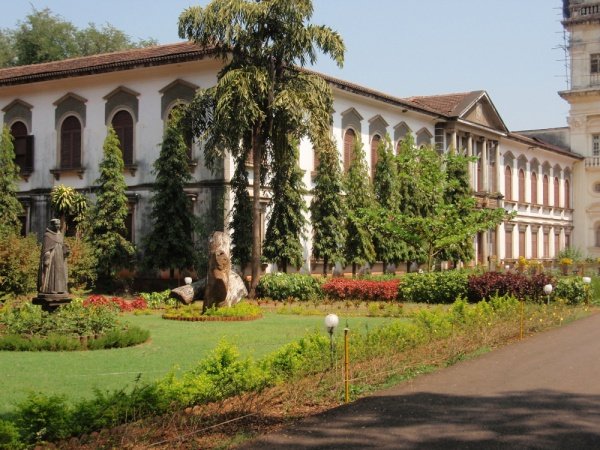
- Archaeological Museum – The museum was set up in 1964. Here you can see artifacts from pre-historic, to the early historic and the late medieval period. There are many wooden sculptures, ornate pillars, portraits, stamps, and objects from the Portuguese times in Goa. Must-see artifacts include the wooden statue of John the Baptist, ivory sculpture of Christ’s crucifixion, and the bronze statue of Albuquerque who was the first governor of Goa.
- Viceroy Arch – The arch is a 5 minute walk from the Basilica of Bom Jesus towards the Mandovi River. It was constructed in 1599 with laterite stone and greenish granite. The Church of St. Cajetan stands next to the arch. There are two statues. The statue of Vasco da Gama faces the river, while the one of St. Catherine faces the other side.
There are other tourist attractions in Old Goa as well, like –
- The Church of Our Lady of the Rosary
- The Chapel of St. Catherine
- The Gate of the Palace of Yusuf Adil Shah
- The Church of St. Augustine
- The Royal Chapel of St. Anthony
- The Convent and Church of St. Monica
All travel agencies offer excursions to Old Goa. You can join a group or go on your own. You will be able to reach Old Goa easily. This is a very nice day trip from Panaji.
Tips For Visiting Old Goa
- How much time is needed to see Old Goa – That depends on how interested you are about culture and Goa’s history. Those really keen and followers of architecture, even make repeat visits to study in detail. But for others, easily 4 to 6 hours is needed. Remember, the attractions are all close, but some walking is still required. So you have to keep time for that.
Walking is easy here, even to the outskirts to see the Chapel of Our Lady of the Mount and the Church of the Cross of Miracles. But it will certainly help you if you have a bike or a car.
- Photography – Most of the attractions are open between 9 AM and 5 PM, all seven days of the week. Photography inside the religious places is not allowed. However, you can take pictures of the structures from the outside.
- Dress – Remember to dress conservatively, as many of them are religious places. You may be denied admission if you are dressed inappropriately.
- When to visit – Old Goa or Velha Goa is extremely popular with tourists from around the world. Weekends can get crowded, especially between November and January, the peak tourist season. Visit on a weekday morning, if you can.
- Guides – Take a guided tour to understand Old Goa better. There are many approved guides from the tourism department of Goa.
- Shopping – You will find many shops and street-side stalls selling souvenirs. The Museum of Christian Art shop, next to the Santa Monica Convent, is a good place to buy. The price is reasonable. Most of the souvenirs are also available at Panjim.
- Food – Drink and food options are limited. There are only a few restaurants here. For lunch, you can go to Cafe Tinto, River Isle, Gazaali Bar and Restaurant, or Master Chef. Café Tinto serves Goan food and seafood. You will also find few places along the road between Panjim and Velha.
- Accommodation – Limited options. Most tourists come to Old Goa on a day trip from Panaji or one of the beach areas.
Fontainhas
You might want to also include Fontainhas along with a trip to Old Goa, as they will both take you down memory lane and give you insights into an old world.
Fontainhas is the Latin Quarter of Goa. A UNESCO Heritage Zone, it is in Panaji, close to Old Goa. Here you will see many old Portuguese mansions with colorful walls, projecting balconies, and windows. There are many art galleries, cafes, and bakeries here. You will get a distinct Mediterranean feel here.
Spend a couple of hours at the Latin Quarter of Panaji and then proceed to Old Goa for 4-6 hours – a day well spent seeing the old world of Goa.
Divar Island
The beautiful Divar Island is located on the opposite bank of the Mandovi River. Leave your car or bike at the Viceroys Arch, take the ferry, and you can reach this mangrove island in only a few minutes. Ferries leave throughout the day from 6 in the morning to 11 in the night. You can return in the same way and then continue your return trip to Panaji.
A part of the island has mangrove swamps, where you can see many birds, bats, and crocodiles. Salim Ali Bird Sanctuary, one of India’s largest bird sanctuaries, is located at the edge of Divar. The island also has four villages, old colonial homes, temples, and churches. There is lush greenery everywhere. Two festivals are held in these villages – Bonderam on the fourth Saturday of August and Potekar, which is like Halloween.
Rate this article: